Tuesday, 4 September 2012

Thoughts from Isaiah

Over the last couple of months Martin and I have been making our way through the book of Isaiah in the Bible's Old Testament.  As we've read I've been struck by Isaiah's contemptuous dismissal of idols and of those who put their trust in them.  Idols are described, in essence, as 'gods' in which people put their trust, but which are actually so powerless that their worshippers look after them, rather than the other way around.

Isaiah is talking about literal idol statues: 'gods' that rely on people to make them, to carry them from place to place, to put them down carefully so they don't fall over etc.  Not many 21st century Pakeha worship such gods, yet we still put our trust in things that require us to tend them.  Money is a common one - requiring us to invest a lot of time and effort carefully making it grow so it can later protect us from hard times.  Houses can be this way, too, when they become more than shelter and morph into a repository of 'equity'.  Reading Isaiah this morning I realised I've allowed Martin's income protection insurance become such an idol.  There's an exclusion on the policy for a medical problem he's had in the past.  If by July 2013 he hasn't had the problem again, the exclusion comes off.  I realised that I've become anxious about that deadline: concerned that the problem musn't come back, even wondering if he should go to the doctor (and hence admit to it) if it does.  I realised today that I've been carefully managing the insurance so that I can put my trust in it, rather than just having insurance but putting my actual trust in God.

Our God is quite different from the idols.  He's not just more powerful, He's also more 'willful'.  Take this, for example, from Isaiah 45:

“Woe to those who quarrel with their Maker,
    those who are nothing but potsherds
    among the potsherds on the ground.
Does the clay say to the potter,
    ‘What are you making?’
Does your work say,
    ‘The potter has no hands’?
10 Woe to the one who says to a father,
    ‘What have you begotten?’
or to a mother,
    ‘What have you brought to birth?’
We are the clay, God is the potter.  We can't question how he chooses to act - even if He chooses to act, as He is here, through an army who is raping and pillaging their way across the landscape. In a way, Isaiah presents us with a simple choice.  We can put our trust in idols, who might look like they do our bidding but who really don't do anything at all; or we can put our trust in God, who will do what He wants rather than what we want, but who is, at least, all-powerful.

It reminds me of this bit of Psalm 115:
Why do the nations say,
    “Where is their God?”
Our God is in heaven;
    he does whatever pleases him.
But their idols are silver and gold,
    made by human hands.
They have mouths, but cannot speak,
    eyes, but cannot see.
They have ears, but cannot hear,
    noses, but cannot smell.
They have hands, but cannot feel,
    feet, but cannot walk,
    nor can they utter a sound with their throats.
Those who make them will be like them,
    and so will all who trust in them.
You can put your trust in the God who does whatever He pleases, or you can be as blind, deaf and immobile as an idol statue - how's that for a choice!

Tuesday, 21 August 2012

Hero rats

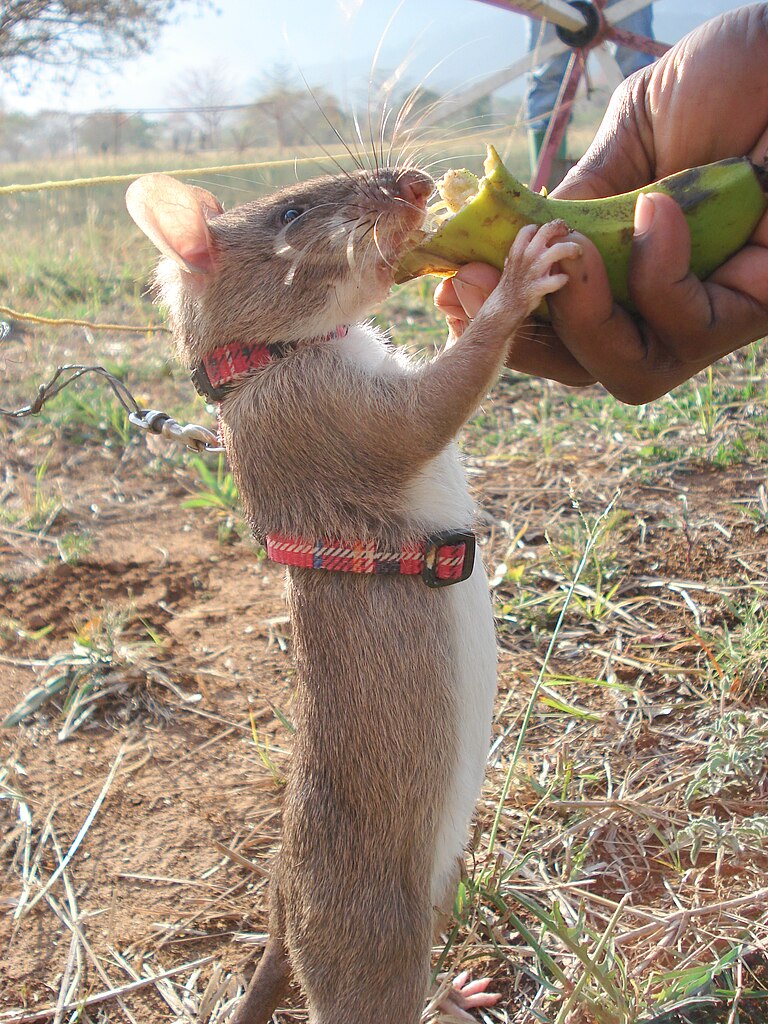
I've just enjoyed listening to an interview from National Radio's This Way Up about one of my favourite charities - Apopo/Hero Rats of Tanzania.  They train African pouched rats to detect landmines in fields in Mozambique and Angola.  More recently, they've also be training these rats to identify patients with tuberculosis by sniffing sputum samples.

The rats they use are enormous.  Look at this one (image taken from Wikipedia).  Good thing they're socialised from an early age to see people as friends!

Thursday, 9 August 2012

Sofa slipcover

We have a wonderful sofa that we inherited from Martin's grandmother.  It's super-comfortable, long enough to spread out full-length on and turns into a remarkably comfortable bed.  I've been wondering for a while, though, about getting it recovered as the fabric looks rather worn-out and some of the tufting buttons have come out.


Then a friend gave me some gorgeous woolen fabric that looked like it'd be big enough to make a slipcover from.  Surely cheaper than proper reupholstering and hopefully a fun project :-)
I've been working at it off and on over the last month or two and yesterday it was finally finished!


I'd started by attaching cords to tie to the front legs of the sofa, with the cords attached to pieces of tape to spread the strain.


Then I'd sewn the front corners, in the process cutting out a roughly square piece of fabric from each.


Next came a cord to keep the fabric snugly in the groove between the seat and the back.


I cut the fabric in line with the cord at each side so that it could sit smoothly on both the seat and the back.  I filled the V-shaped gap thus formed with fabric that, had I not cut it off, would have been hidden under the wood that supported the arms anyway.


Lastly I needed to tidy up the back.  The fabric wasn't quite long enough to go over the top of the sofa so I attached some black calico to extend it.  This actually took about as long as the whole rest of the project as it involved lots of hemming!  Once attached, I stitched in the folds on the top corners of the sofa, in the process stitching the squares I'd removed from the front corners onto one of the sides (it turned out I hadn't attached the fabric to the sofa as symmetrically as I'd thought...).


All done!

Saturday, 4 August 2012

Marriage equality bill

In New Zealand, a members bill is currently being debated in Parliament which, if passed, would extend marriage to homosexual as well as heterosexual couples. My instictive reaction has been that, on the whole, I would like this bill to be passed - i.e., I'd like NZ to legalise same-sex marriage. This doesn't appear to be the common Christian position, but my thinking on the matter has been significantly influenced by reflecting on the situation of a young family who used to live over our back fence: a family made up of two adult women and one preschool girl.

As I came to care for them, I began to be concerned about how one particular part of NZ law affected them.

Under current NZ law, children can only be adopted by either single people, de facto couples or married couples.  As only heterosexual couples can be recognised as being either de facto married or actually married, that means that gay couples cannot adopt.  One member of a gay couple can adopt a child on their own (as singles can adopt) and they can then raise that child together, but legally, only one of them is that child's parent.

In general, that could be fine.  But, if the legal parent is away from home on business and the child suddenly has to go into hospital, the other partner isn't that child's legal next of kin.  They can't make decisions about the child's care, they can't visit them and reassure them in intensive care etc. etc.

That seems to me to be hugely contrary to that child's wellbeing.  As I read the Bible prior to the last election, trying to work out what kind of rulers God appeared to be in favour of, again and again I found that he wanted rulers who watched out for the concerns of the weakest members of society.  Preventing both of a child's actual parents (at least from the child's point of view) from being recognised as their legal parents appears to me to be harmful to the interests of that child - one of society's weakest members.

At first, one might think you could shore up this situation by preventing adoptions by single people.  But of course, single-person-adoption isn't the only way a homosexual couple can end up raising a child.  All a lesbian needs to get pregnant is a syringe and a cooperative friend.  (I guess that's all a gay man needs, too, although in his case the degree of cooperation required is somewhat more substantial, and adoption law still comes into play once the baby is born.)  However, when that lesbian woman gives birth, there is currently no way in which her partner can be recognised as a parent of that child.

So, in a world in which it is so easy for lesbian women to have babies and for them to raise them with their partners, is it just to deny those children the option of being legally adopted by their non-giving-birth-to-them mother?

Of course, allowing homosexual couples to marry isn't the only way to resolve the situation outlined above.  But I expect that most Christians would have a similar level of distaste for extending the right to adopt children to homosexual couples (whilst still preventing them from actually marrying) as they seem to have for 'marriage equality'.

That said, the folk at 'Protect Marriage' raise a few points that give me pause for thought.  For example, it does seem plausible to me that 'marriage equality' could lead to more heterosexual divorces and fewer heterosexual couples choosing to have children, and neither of those are outcomes that I'm in favour of.  But I keep on coming back to the wellbeing of our little former neighbour, and I think that 'marriage equality' for her parents really would be in her best interests, at least.

Sunday, 13 May 2012

A delicious discovery


Many years ago I learnt to make quince pâté/paste: a delicious concoction that you can serve on crackers with cheese or simply nibble on on its own.  Then a year or two ago I purchased guava paste - the same general idea, but made from tropical guavas.  Right now we're in the middle of a major guava glut so I decided to have a go at making guava paste with our own strawberry guavas.  The result was delicious.  We've simply been cutting it into cubes, rolling it them in caster sugar and eating them like jubes although think it'd be nice on crackers with cheese as well.

Should you like to have a go at making your own guava 'jubes', it's very simple.

1. Simmer guavas until soft with a small quantity of water (just enough to stop them burning - we used about 1/3 cup water to 2 litres guavas).
2. Pass through a mouli to remove all the seeds (you could force them through a regular seive if you didn't have a mouli, but it'd be a bit of a pain).
3. Put the pureed guavas in a wide pan with an equal volume of sugar (we used our big preserving pan and the high sides were great as they meant that the splatters were contained as the paste was cooked down).  You only want about 2-3cm of puree/sugar mix in the bottom of the pan.
4. Bring to the boil and cook, stirring constantly, until the mix has reduced to about half the volume and you can draw a wooden spoon right across the pan before the trace fully closes up.
5. Pour into non-stick containers to about 1cm depth and leave to cool (which will take hours - it holds its heat amazingly).

Store between layers of baking paper in air tight containers.  Should easily keep more than a year.  Yum!

Wednesday, 9 May 2012

TED talk on energy

A few weeks back Martin and I watched this TED talk entitled 'People, Power and Area'.  It's by one of my heroes - British physicist David Mackay who not only wrote the program I use to type using only a mouse but also wrote the wonderfully informative book Sustainable Energy Without the Hot Air.  I appreciated his clear explanation of why we can't just switch to renewable energy and otherwise carry on living 'business as usual'.  I was also stunned to learn that the UK and Saudi Arabia both had the same amount of fossil fuels under their soils (one in coal, the other in oil) before extraction started.  I hope to be able to direct people to this talk in future as a good, clear explanation of where the world is at in terms of energy availability.  To be honest, I do find a clear explanation of where we're at kind of scary, and it drove me to pray - thanking God that He is in control and pleading for his mercy in this dire situation.

Wednesday, 18 April 2012

Over the last couple of months I've been working on my latest piece of writing for ANZMES, New Zealand's national support organization for people with CFS.  Martin's now put it up on our website and you can read it here.